


Maya, 26
MOUNJARO · 2 MONTHS IN“Everyone said I was too young for thinning. My plughole disagreed. Week 6 and it's finally slowing.”
NEW CUSTOMER OFFER · ENDS TONIGHT
Free £30 Scalp Stamp + free UK shipping on 3+ bottles

One-time · Up to 180-Day Guarantee


A copper-peptide serum that takes the cuff off your follicles so your parting can fill back in. One line along the parting, once a night.
DISCOUNT AUTO-APPLIED

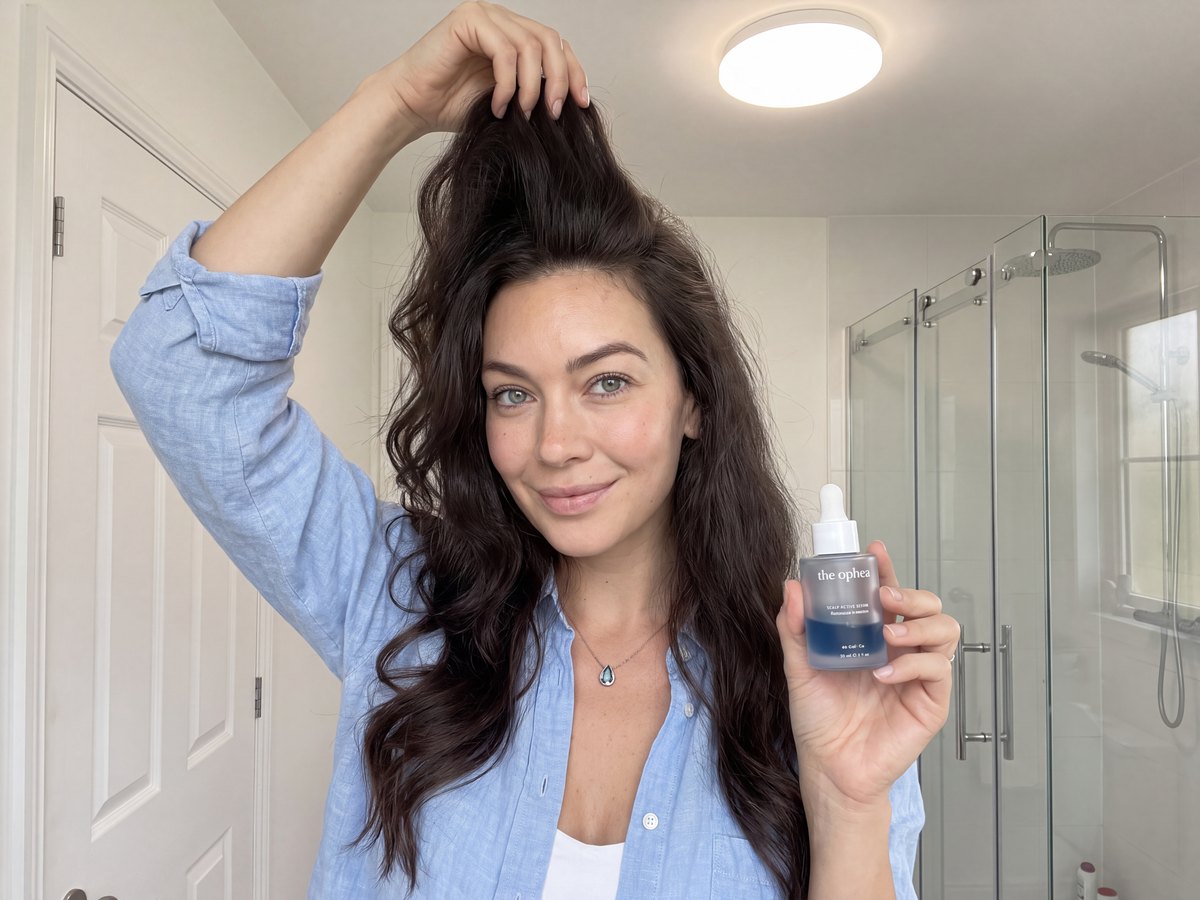
"Week 10 and the shower drain is finally clear. My parting is actually filling back in. I cried happy tears for the first time in years."
Amelia K., 34 · 11 months on Mounjaro · Biotin, rosemary oil and minoxidil did nothing. 150 nights of The Ophea did this.
One-time purchase — no subscription, no auto-ship. Just the serum.
Secure 256-bit SSL encrypted checkout
“Everyone said I was too young for thinning. My plughole disagreed. Week 6 and it's finally slowing.”

“I screenshot my parting every Sunday. First time the line's got thinner, not wider.”

“Twenty years of hair vitamins. This is the first bottle that touched the cause.”

“The postpartum shed never stopped for me. Eight weeks in, my brush is almost boring.”

“Nothing clashed with my meds. That was my biggest fear, gone.”

“My endocrinologist actually asked what I'd changed. That never happens.”

“Minoxidil's shed broke my heart once. This built me back without the horror show.”

“At 56 I'd made peace with scarves. My crown hadn't. Baby hairs everywhere now.”

“I stopped booking the thinning cut. My hairdresser noticed before I told her.”
16 licensed clinicians reviewed The Ophea. Filter by what you care about: each concern has a clinician who breaks down the science.
Clinicians receive free samplesTo form a hands-on, first-party opinion of the formula.
Never paid for a reviewNo clinician is financially compensated for what they write.
Collected independentlyA third-party clinical review process, not The Ophea.

Trichology
“Most serums list GHK-Cu at trace levels. Four percent is the concentration the published work actually used, and it shows in the parting first.”
In clinic I see women who have cycled through biotin, oils and worse for years. What convinces me here is the honesty of the formulation: one active, at a meaningful dose, applied where the problem lives. The parting line is where follicle miniaturisation shows earliest, and it is where recovery shows earliest too.

Dermatology
“Unlike minoxidil, there is no initial shedding phase to push through. For women already anxious about every hair in the brush, that matters clinically.”
The first six weeks of any hair treatment decide whether a patient stays the course. A protocol that reduces shedding without the notorious early drop keeps women consistent, and consistency is what regrows hair.

Endocrinology
“A topical peptide with no hormonal or systemic activity sits comfortably alongside Mounjaro, Wegovy or Ozempic. That is the first question my patients ask.”
Patients on a GLP-1 are already managing a serious medication. The advantage of a non-hormonal topical is that it adds a local mechanism without touching the systemic picture, so there is no interaction conversation to have.

General Practice
“The best treatment is the one still being used in month three. A single nightly line along the parting clears that bar better than anything twice-daily.”
Adherence is the quiet variable behind every before-and-after. When I recommend a routine, I am really recommending whatever the patient will still be doing in twelve weeks, and a one-minute nightly step is exactly that.

Trichology
“A miniaturised follicle is dormant, not dead. Catch it inside that window and it can be called back. Wait years, and the window closes.”
The most important thing I tell women is that thinning is a spectrum, not a switch. For most of the women I see, the follicles along the parting are still alive and still capable of producing terminal hair. What they need is for the local pressure to come off. That is precisely the job a follicle-level peptide is suited to.

Endocrinology
“Blood tests can come back normal while the follicle is drowning. In PCOS the follicle itself over-responds to androgens, which is why a scalp-level approach makes sense.”
Patients are often confused when their labs look fine but their parting keeps widening. The explanation is receptor sensitivity at the follicle, not just circulating hormone levels. Addressing the tissue that is actually struggling is a rational, targeted strategy.

Clinical Pharmacology
“The five-hundred dalton rule is the gatekeeper of topical delivery. GHK-Cu passes under it. Most 'actives' in hair serums never get through the door.”
A topical is only as good as its ability to reach the target tissue. Molecular weight is the first filter, and it is unforgiving. This is one of the few hair actives whose size, charge and data line up with the delivery story on the label.

Dermatology
“Excess shedding means too many follicles slipping into the resting phase at once. Shift the cycle back towards growth and the plughole quietens within weeks.”
Telogen dominance is the mechanism behind the handfuls women describe. It responds to changes in the follicle environment faster than density does, which is why less shedding is usually the first win a patient reports, well before new growth is visible.

Women's Health (GP)
“A non-hormonal topical adds nothing to the systemic picture. For women already balancing a weekly injection, that simplicity is the point.”
The question I am asked most is whether adding a hair product will disturb the medication that is finally working. With a local, non-hormonal mechanism the honest answer is no. It works in the scalp, and stays there.

Hair Restoration Surgery
“Surgery is for follicles that are gone. Everything before that point is a fight worth having topically, and the earlier the better.”
By the time a woman sits in a transplant consultation, she has usually spent five years trying things that never addressed the follicle. The strongest advice I can give is to intervene while the follicles are miniaturised rather than absent. That window is where topical actives earn their keep.

Cosmetic Science
“No fragrance, no silicones, no drying alcohols. Every exclusion removes a reason for an irritated scalp to sabotage the treatment.”
Formulating for a compromised scalp is mostly the discipline of leaving things out. Fragrance is the most common sensitiser in leave-on products, and silicones can build an occlusive film exactly where you want delivery. A short ingredient list is a clinical decision here, not an aesthetic one.

General Practice
“Hair loss causes the stress that causes more hair loss. The first visible slowdown in the brush breaks that loop, and everything gets easier from there.”
The psychological weight of shedding is itself follicle-hostile: cortisol is no friend of the hair cycle. When a patient sees the shed calm down, anxiety drops with it, and the biology and the psychology finally point in the same direction.

Trichology
“Microcirculation at the crown declines exactly where thinning shows first. Waking that supply line up is the least glamorous, most important job in regrowth.”
We image scalps every week, and the pattern repeats: the zones with the weakest perfusion are the zones with the thinnest hair. Follicles are among the most metabolically demanding structures in the body. Feed the tissue, and you change what the follicle is capable of.

Endocrinology
“In PCOS, insulin resistance amplifies androgen pressure on the follicle. Manage the metabolic side with your doctor, and give the scalp its own dedicated support.”
I encourage patients to run both tracks at once: the systemic work with their clinical team, and local follicle support at home. Neither replaces the other, and the women who do both are consistently the ones whose photographs change.

Dermatology
“The itch and flake many women report on minoxidil usually comes from the vehicle, not the drug. A water-light, glycol-free serum spares the scalp that fight.”
Irritant contact dermatitis is one of the commonest reasons women abandon topical treatment. Removing the classic culprits from the vehicle means the scalp barrier stays intact, and a calm scalp is a precondition for everything else we are trying to achieve.

Menopause Medicine
“The hair did not suddenly become weak. Its protection thinned. Supporting the follicle directly is the logical response to that arithmetic.”
Through perimenopause the oestrogen-to-androgen ratio shifts, and hair that was defended for decades finds itself exposed. That is why thinning can arrive seemingly overnight in the mid-forties. A local strategy meets the problem exactly where the arithmetic changed.
The fat the pen burns there is what your hair restarts from. Four steps. Your GP stopped at step two. Step four is where your hair actually goes.
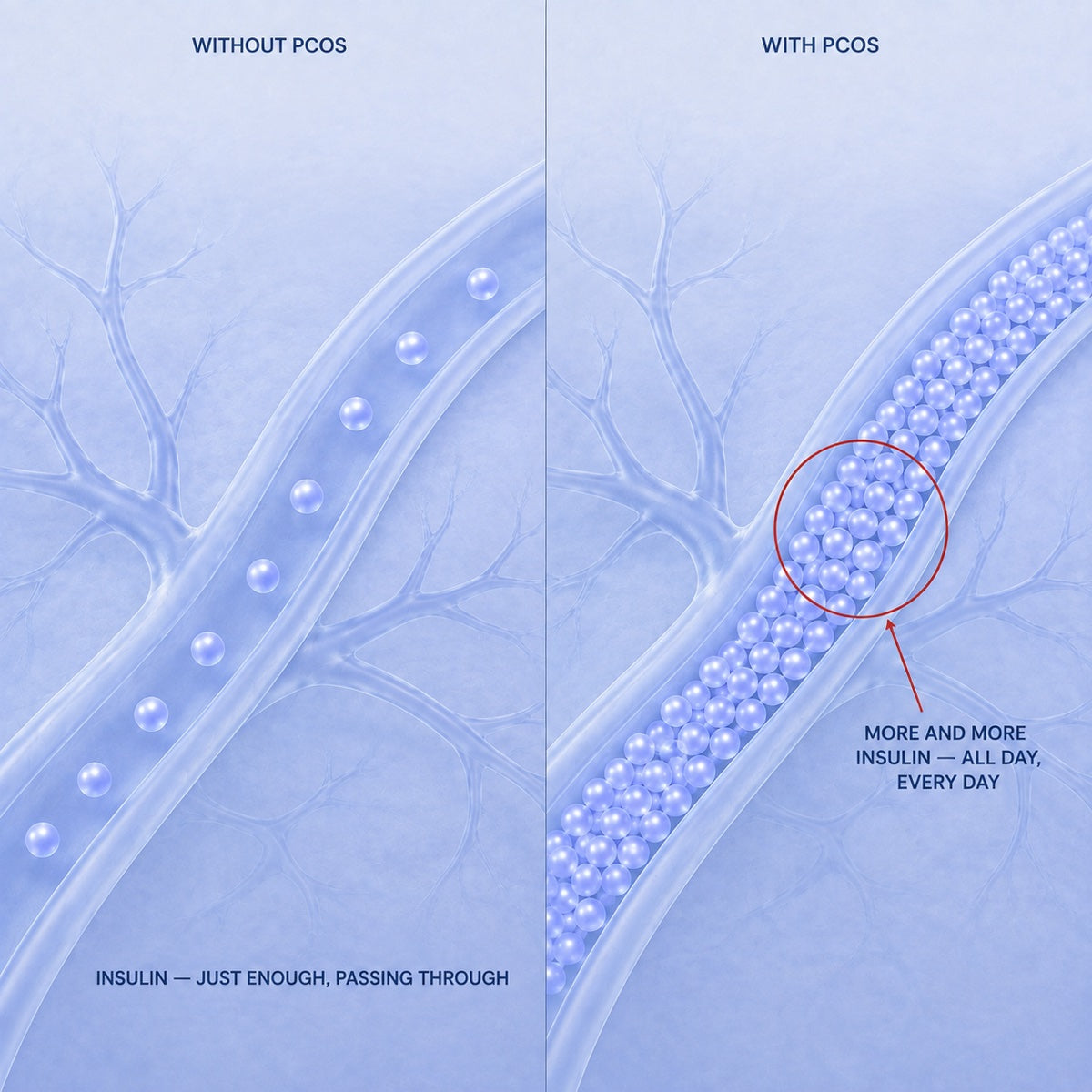
The pen does one thing brilliantly: it puts your body into fat-burning mode and keeps it there, all day, every day, for months. Nothing you did wrong. It is the point.
Lose more than 20% of your weight and the trial rate of hair loss doubles. Mounjaro runs nearly twice Wegovy.
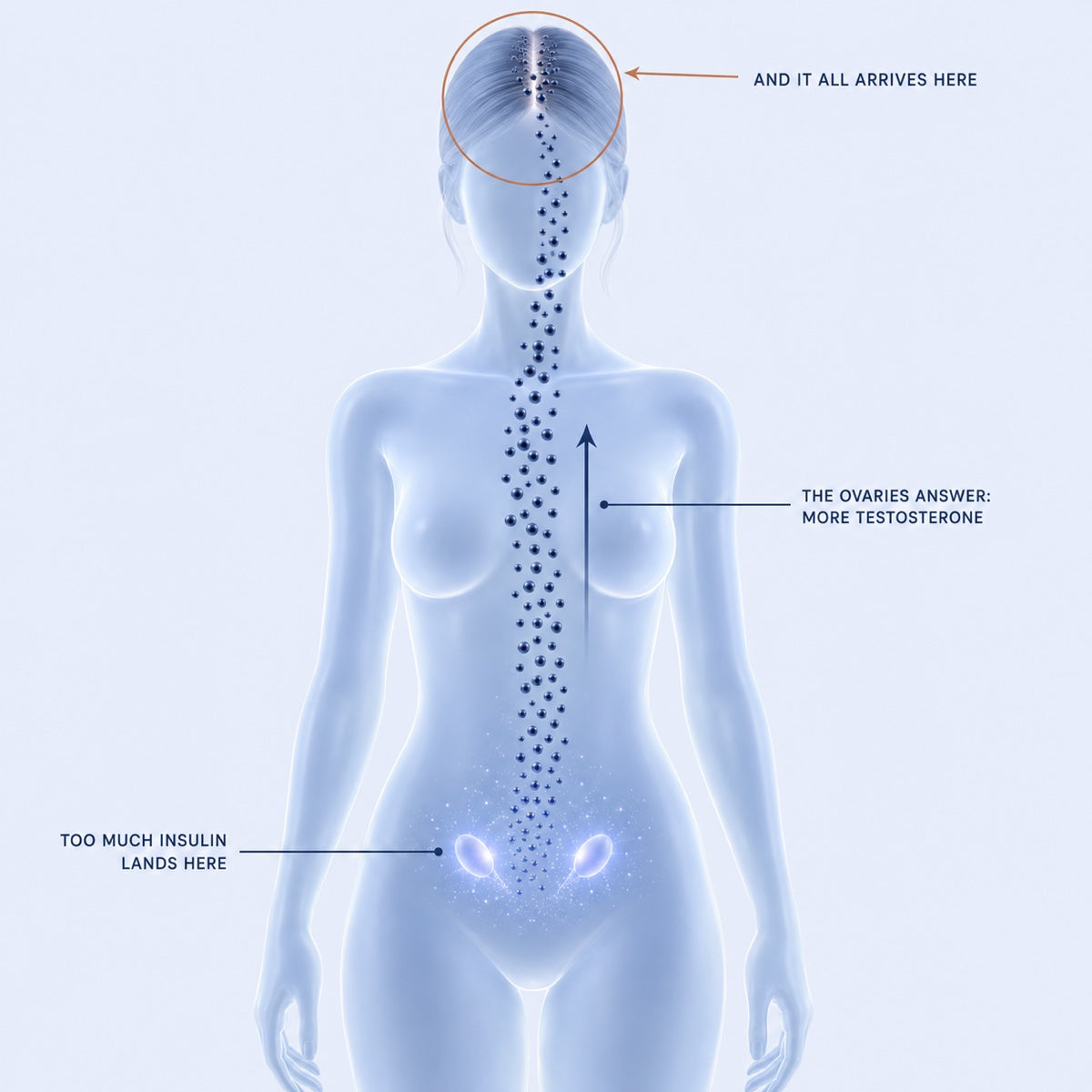
Weight coming off this fast reads as an emergency. Your body pulls a whole batch of roots into rest at once. Six to twelve weeks later they let go together: the plughole, the brush, the pillow. Your GP calls it telogen effluvium and says six months. This is where she stops.
Shedding lands 6 to 12 weeks after the pen, and again after every dose step. Count back.
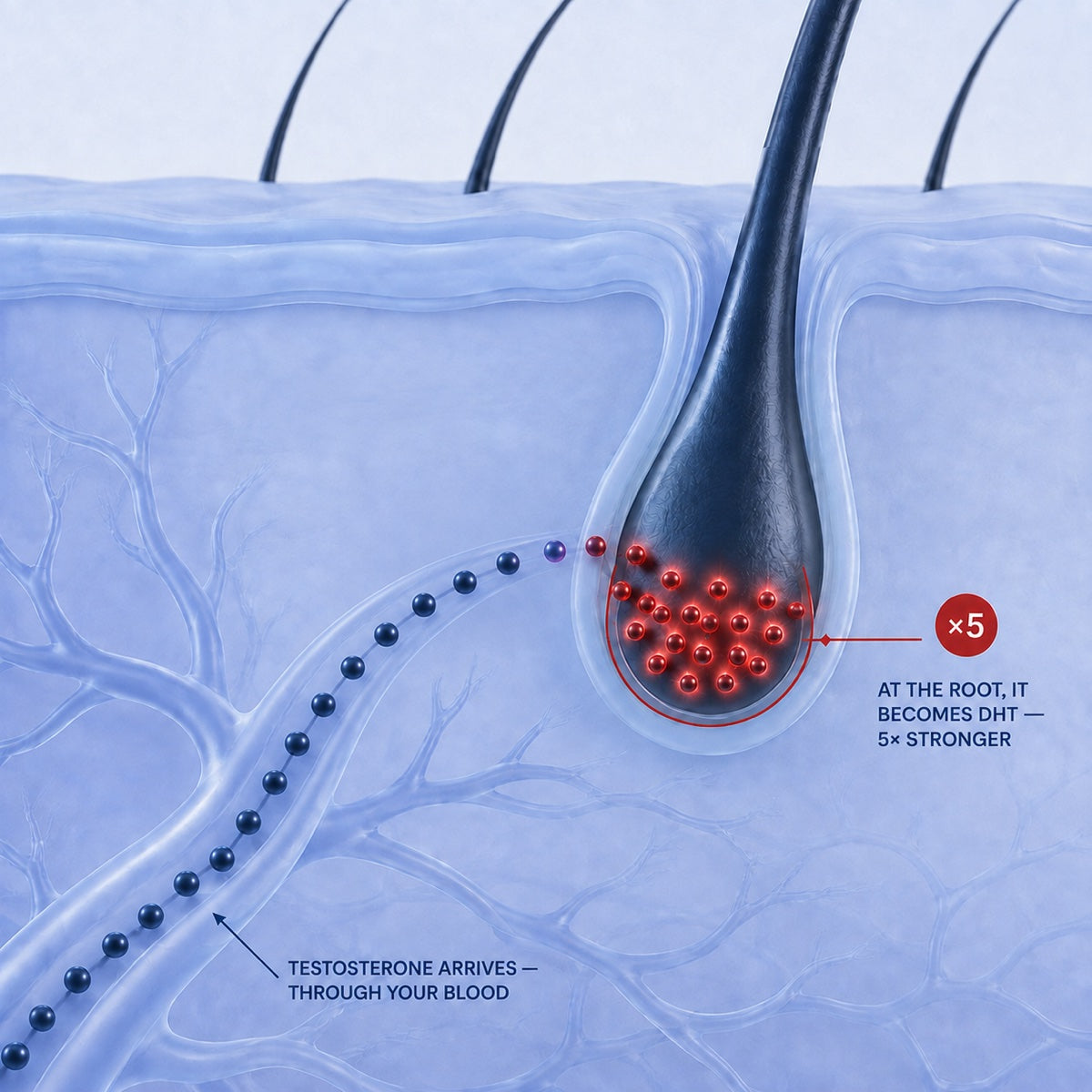
Every root sits inside a small cushion of fat, four millimetres down: the fuel and the shield for the button that starts each new hair. The pen does not know the difference between the fat on your hips and the fat round your roots. It burns both. And burning fat spills acid on whatever sits next to it.
In fasting animals, the fat round the follicle went into full burn within 24 hours.
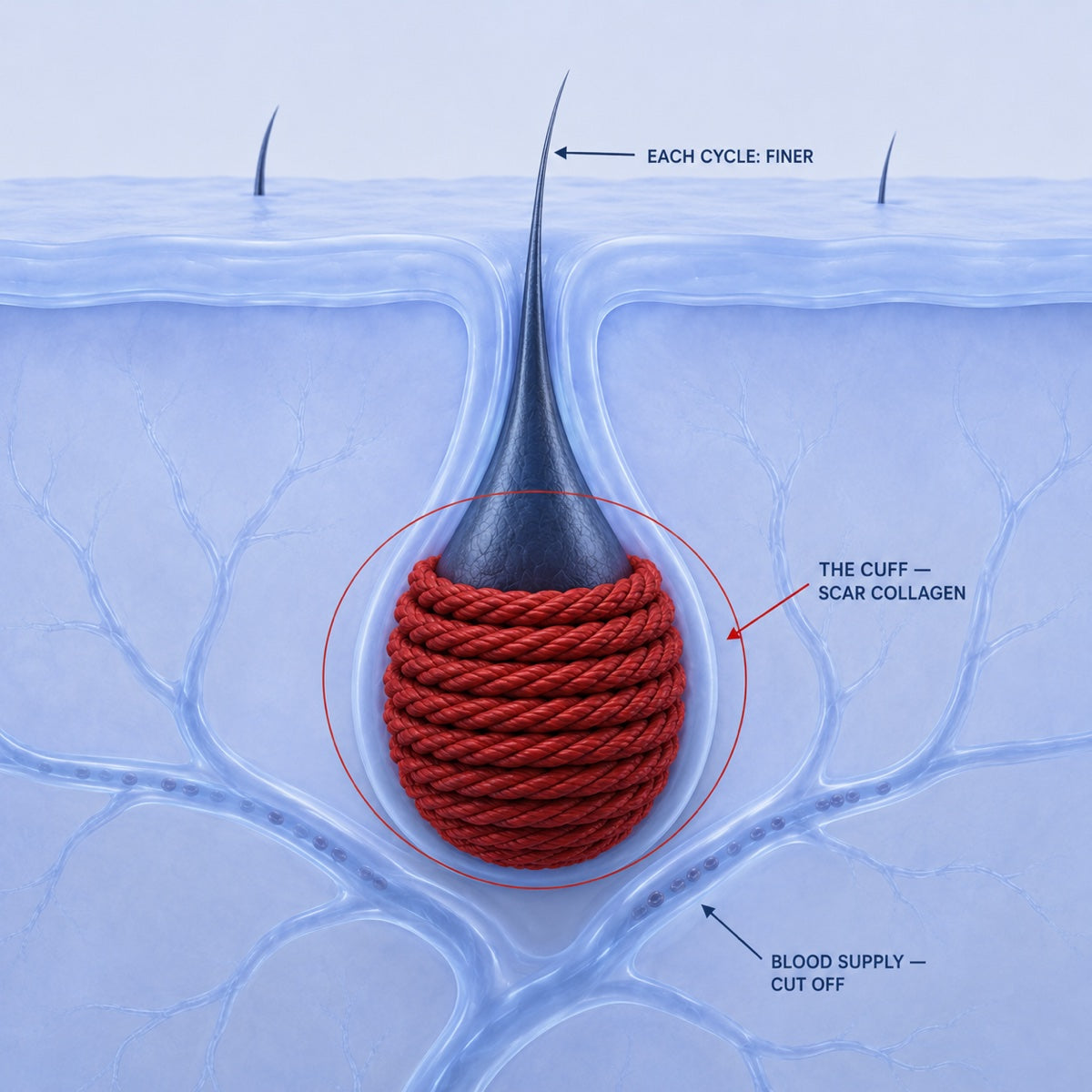
Your root finishes its rest right on time. The button fires. A new hair starts. And it walks straight into the burn: the cells that just switched on die, and the root drops back into rest. Tries again. Same fire. Every dose step lights it again. We call it the Burned Restart.
Every dose step lights it again. The hair you have today is the most you will have, until something reaches the button.
Every sign you have, one cause. That is how you know it is the right one. Not your protein. Not your discipline. Not your age. The address.
The plughole fills. Then it goes quiet, and the parting keeps widening.
Every product you’ve tried stops short of step four. The Burned Restart is step four. The only step where the hair actually goes.
A root whose restart keeps dying can’t use it. So it went to your nails and your chin while your parting kept widening. That was the consolation prize.
A review of every published biotin case found benefit only in women who were deficient. In healthy women: no evidence it grows hair.Patel, Swink & Castelo-Soccio, Skin Appendage Disorders, 2017
Sold as a natural stimulant. It never gets through the skin to where the restart dies. Months of greasy massage, never reaching the pocket. Thousands flushed.
Its one trial ran on 100 men and only matched minoxidil 2%, the weakest dose, after six months. Nothing about a woman on a GLP-1.Panahi et al., Skinmed, 2015
Iron, saw palmetto, ‘four lanes’. Everything you swallow goes into blood, and blood never visits the pocket. Your labs came back normal because the materials arrived. Nobody handed the button an order.
The largest review of GLP-1 hair loss found it is mostly telogen effluvium from rapid weight loss, self-limiting only when the trigger stops. Not a hormone you can swallow away.Gupta et al., systematic review, 2026
Forces blood at a button with no order. First the shed that made you cry. Then greasy, twice a day, for life. Stop, and it takes it all back.
It’s on the maker’s own label: stop using it and you’ll probably lose the new hair within a few months. Rented, by their own admission.Rogaine (minoxidil) product label
Whether it cost £8 or £89 a month, not one of them was aimed at the button. You didn’t fail four times. Four products never entered the pocket.
You were never failing. You were sent the wrong way in. Pills go into blood that never visits the pocket. Oils stay on skin that lets nothing through. The Ophea puts a true 4% copper order on the button itself, while the pen stays in the fridge.

The order gets to the button.
GHK-Cu is a copper peptide of about 400 daltons. Skin lets almost nothing through, but its cut-off sits near 500. The copper is under it. One line along the parting at night, where every follicle opens to the surface, at a true 4%: what arrives is an order, not a whisper.

The button hears it.
GHK-Cu is the copper peptide your body uses to order tissue to rebuild. On the button it multiplies the cells that decide whether a hair grows, calls in new vessels, and turns down the ‘stop’ signal that pushes a root into rest. The roots about to let go get the order first. That is why the plughole goes quiet before anything grows.

First the plughole. Then baby hairs that stay.
A root that has been through failed restarts is measurably short of one amino acid, arginine, and its own pump for it has shut. Put back at the root, human follicle tissue switched back on. Glycerin keeps the pocket calm. The new hair comes through the burn with the order in hand and keeps going: baby hairs that stay, not the ones that come and vanish.
Shelf ‘copper peptide’ serums carry a trace, under 1%: enough to print on the box, not enough to hand a button an order. A true 4% is on our ingredients list, in black and white.
0 hormones. Nothing to stop. The pen stays.
Ask it of everything on your shelf and you will see why the shelf failed. Now you know what to check.
Pills feed the blood. Oils feed the surface. The Ophea hands the button its order, at the root, at a true 4%. There’s no third option on the shelf.
Every woman below is on a GLP-1. Every one was told to wait it out. Look at the partings.
 Before
 After
After
Aisha R., 29
4 months“Sixty-odd strands in the plughole every shower. This morning I counted nine. Nine.”
 Before
 After
After
Claire D., 42
5 months“The hairdresser lifted the back, went quiet, and asked what I'd changed. I'd dreaded that chair for two years.”
 Before
 After
After
Joanne P., 45
6 months“My parting's back to the width it was at 30. I measured. I've got the photos.”
 Before
 After
After
Megan L., 27
4 months“Baby hairs all along my parting, standing up like they had somewhere to be.”
 Before
 After
After
Becky S., 36
3 months“First time in three years I've worn it down to work without checking the back in the lift mirror.”
 Before
 After
After
Leila A., 25
5 months“My sister grabbed my ponytail and said 'when did this get thick?' I nearly cried over the kettle.”

Credit where it's due: minoxidil is a licensed medicine with decades of trials, and it does push hair out, for exactly as long as you keep paying and applying. It rents you hair. We'd rather fix the root once, and let you keep what grows.
The copper peptide your body carried in abundance at 20 (about 200 ng/mL in plasma) and has less than half of by 60. Right there on the safety sheet: 4%. Not a ‘proprietary blend’, not a token sprinkle. 4× the strongest copper-peptide serum on the retail shelf, and up to 4,000× the parts-per-million sprinkle most brands call ‘contains copper peptides’. It remodels the cuff, wakes the papilla, feeds the root.
The amino acid your body turns into nitric oxide, the micro-circulation signal that keeps the root fed while the cuff comes off.
Pulls water into the scalp barrier so a wake-up this strong never turns into a tight, flaky scalp. Five percent: the exact dose a randomized human trial moved hydration +59% with, in one hour.
Named, because you read labels: one keeps it clean without parabens; the other holds the no-drip gel. That’s the whole label. Six ingredients. One dose that matters.
No rinse. No residue. No twice-a-day foam to plan your mornings around.
Drop
A line along your parting and temples. Dry or damp hair, either is fine.
Massage
Thirty seconds with your fingertips. Then bed. The peptide does the rest.
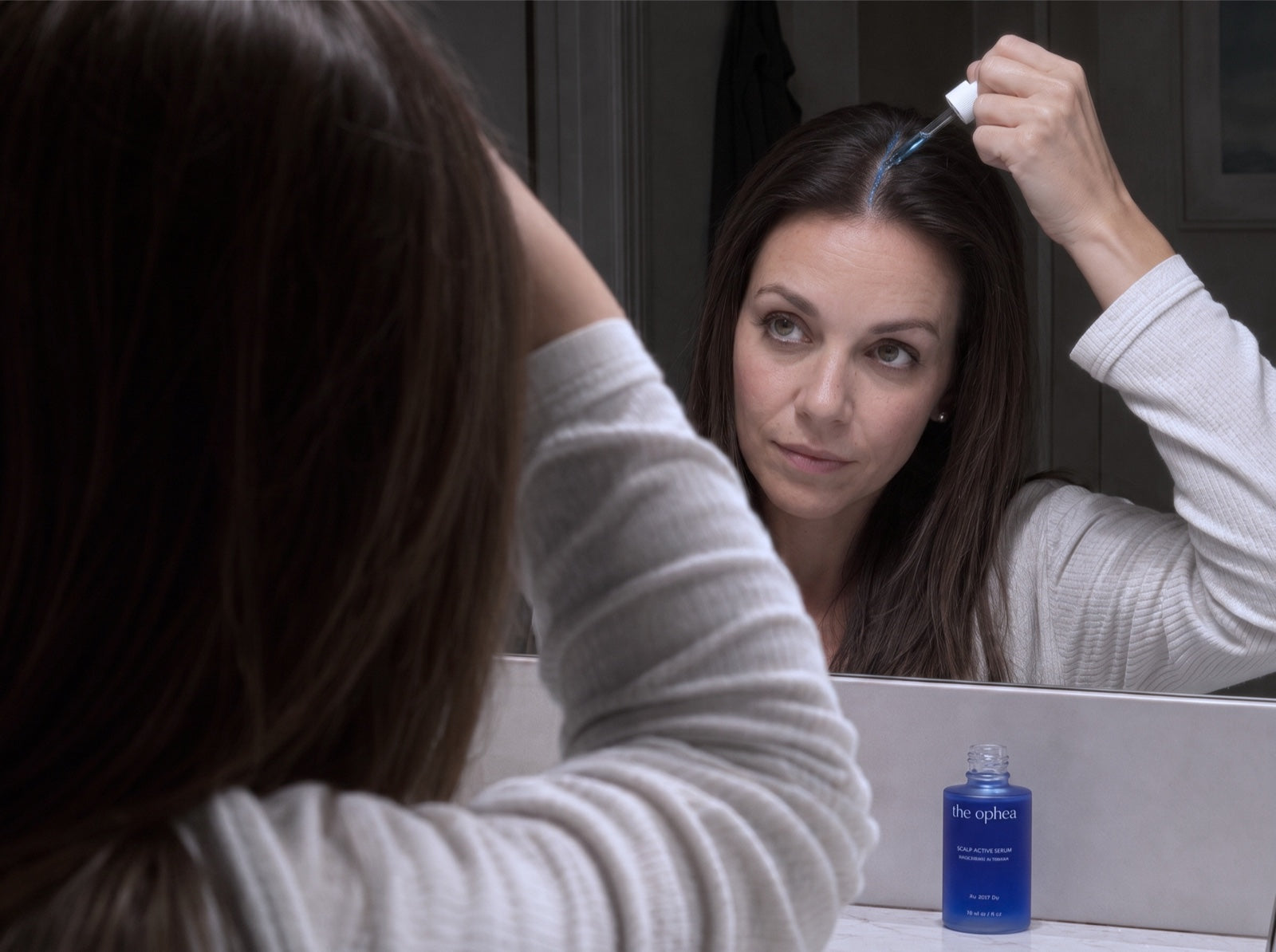
The copper is on the parting. The foam stays in the drawer. You stopped paying the ransom. Under the surface, the signal starts. You won't see it yet. Your roots will feel it.
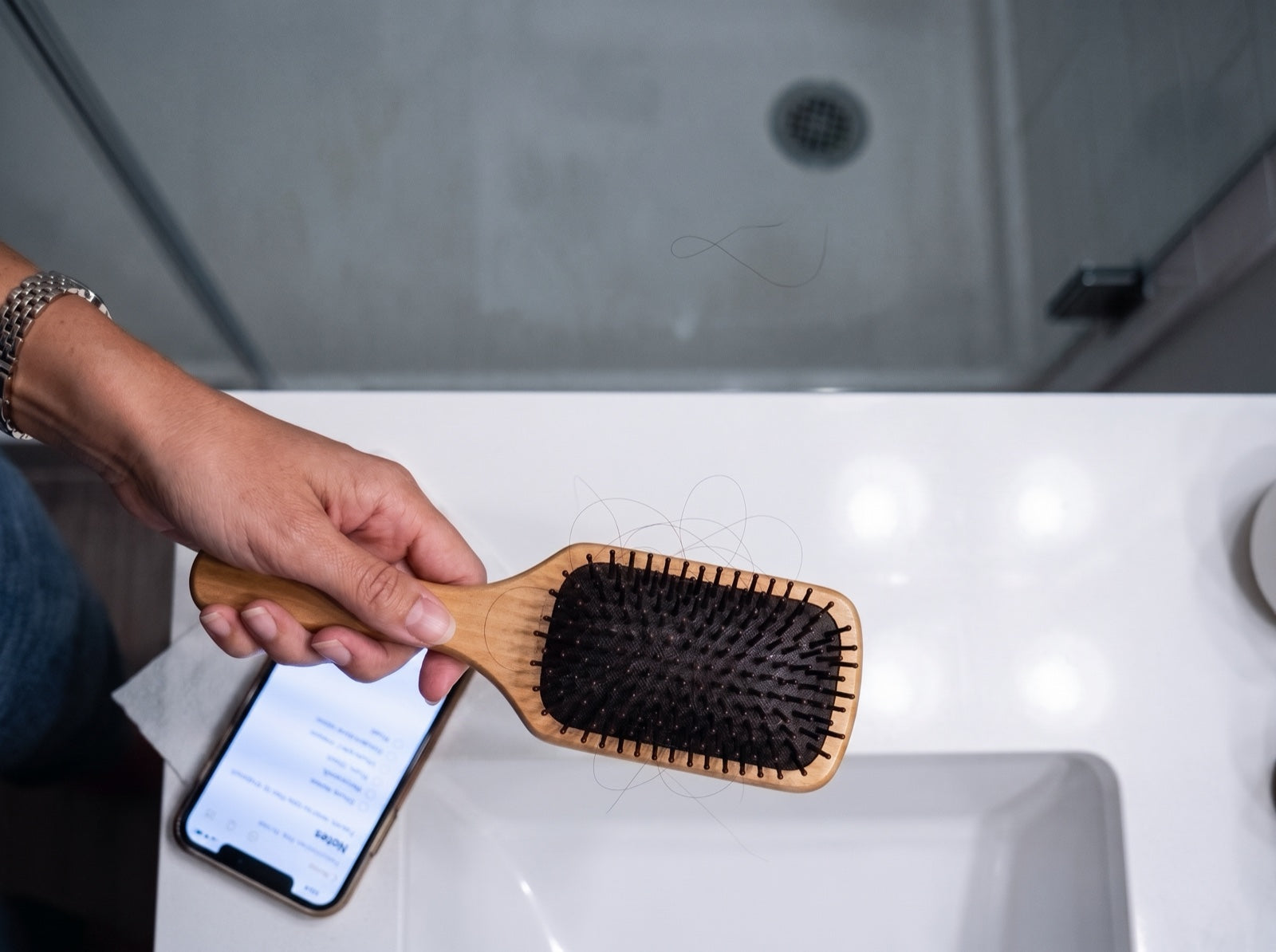
Dormant roots re-enter the growth phase. Run your own count: pillow, brush, drain, same day each week. If the count blips UP at first, read it right: that's old resting hairs pushed out by the new cycle underneath. Then comes the first wash day you don't brace for.
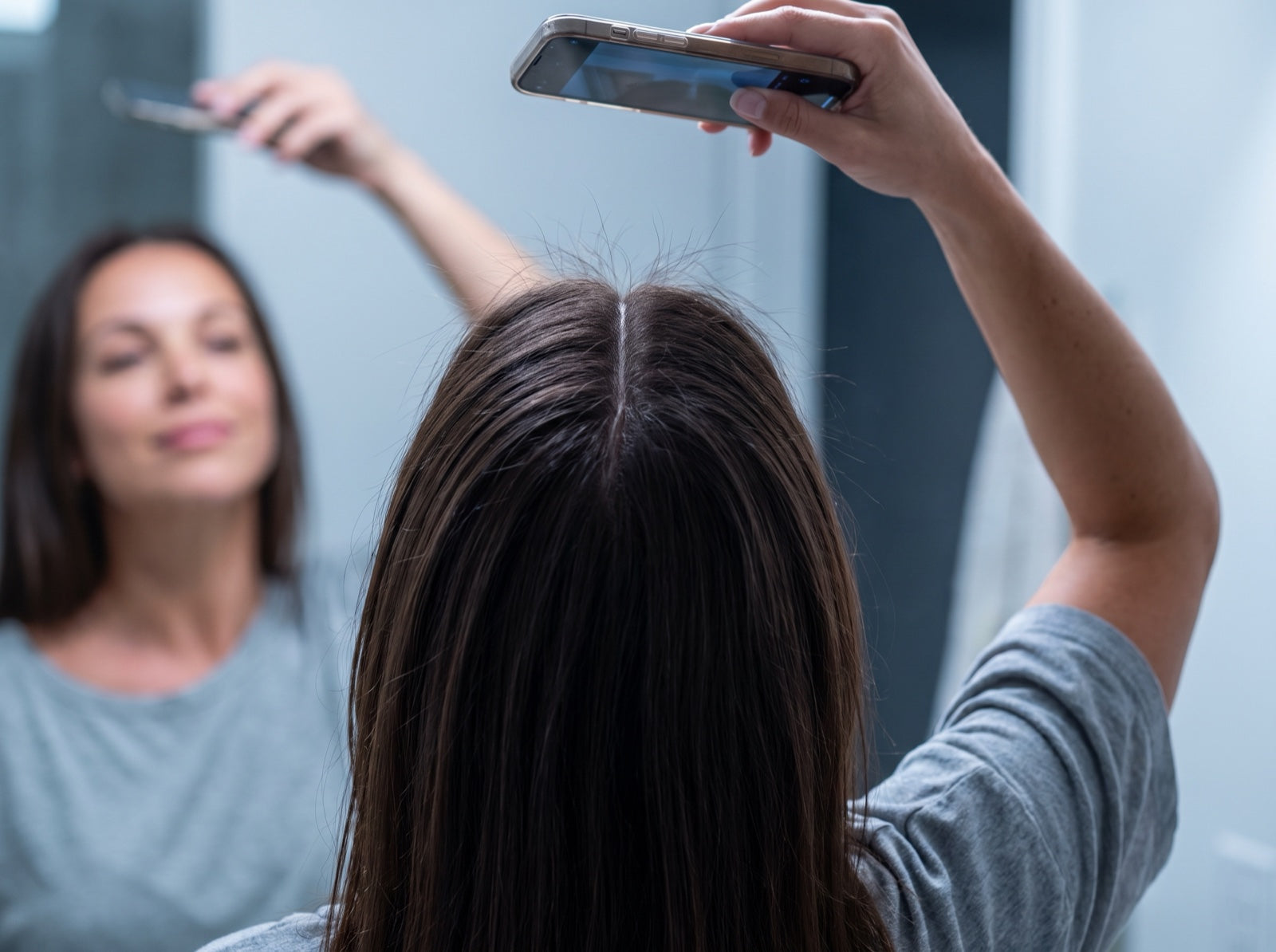
Baby hairs you can photograph. Density you can feel: the bobble goes round one less time. And the first to notice won't be you. It'll be your hairdresser, mid-cut. This is where you judge us: the Guarantee below is built around exactly this checkpoint.
📏 A ruler on your parting, once a week, same spot.
📸 One photo, same mirror, same morning light, every Sunday.
Your numbers. Your light. Your proof. Nobody can spin that. Not even us.
“This is why the Protocol is 3 bottles. 90 days is your roots' biology, not our offer. Selling you one bottle would be selling you half a wake-up.”
 2:47am
Dr. Paige Brennan
Stanford-trained Dermatologist · Founder, The OpheaIf you've ever cleared the shower drain before anyone else could see it, or quietly moved your parting because the old one started showing scalp, I don't need to explain any of this to you.
2:47am: photographing the top of my own head, comparing it to March. And here's the part that still makes me angry. I'm a Stanford-trained dermatologist, and when it happened to me, I got the same sentence I'd been trained to give: ‘Everything looks normal.’ As if normal is how any of this feels.
Normal wasn't an answer. Deep in wound-healing research no shampoo brand ever quotes, I found it: a copper peptide called GHK-Cu kept doing something strange. Where damaged skin was rebuilt with it, hair grew back around the site. Thick. Uninvited. The roots weren't being fed. The Cuff was coming off them.
The labs told me 1% was ‘industry standard’: cheaper, easier, invisible.
I refused.
Twelve weeks later: baby hairs along my parting, standing up like they had somewhere to be. I didn't build another hair product. I built the exit.
Nobody was building this for women like us. So we did.
Dr. Paige Brennan
Founder, The OpheaWe know exactly how many times you've been burned: by promises, by subscriptions, by 30-day guarantees taped to 90-day products, by bottles that worked on the model and never on you. So here is THE GROW-BACK GUARANTEE, in plain English — it runs the full window of your pack: 90 days on the 3-month Protocol, 180 on the 6-month. Run your Protocol. Judge it at the Week-12 checkpoint, with your Sunday photos, your ruler, your light. If you're not looking at visible new growth, for any reason or for no reason at all, every penny comes back. No returns to post. No forms with trick questions. No photos demanded, no interrogation, no judgments made. Keep the empty bottles. Keep the bonuses. We can only write a guarantee this reckless because the cuff comes off when the dose is real. The risk is ours now. It was yours for long enough.
— Dr. Paige Brennan, founder
THE PROCESS, PUBLISHED
Any day within your pack's window: 90 days (3-month) · 180 days (6-month)
email Sophie at hi@theophea.com
say "it wasn't for me". That's the whole script
every penny back within 48 hours, a human confirms it.
No stunt here: until the reviews arrive, the promise is the proof.
Which leaves exactly one risk on the table: another 90 days of watching the drain, for nothing.
Every month under the cuff, a handful of your stuck roots stop waiting. They slide from asleep to silent, miniaturised past the point where anything can call them back. That's the brutal arithmetic of hormonal loss: it compounds. And another month of 'hair vitamins' is not a test. It is the same year, billed again: £300+ to the old way, for jars that never asked why. Ask any woman in the after photos what she'd change. It's the same five words, every time:
'I wish I'd started sooner.'
You know the moment. 11:47pm, the bathroom light you hate, phone camera angled at your crown, checking the parting the way you always do when no one's watching. Nothing bad happens tomorrow. That's the trap. Tomorrow looks exactly like today. The month after doesn't.
One is six months into regrowth: her hairdresser pausing mid-cut, the restaurant bathroom mirror just a mirror again.
The other is six months deeper: another family photo she offered to take so she wouldn't be in it. Again. Another Sunday not measuring, because not knowing feels safer than knowing. The bun tighter, the 2am scroll through 'female hair loss 50+' with the brightness turned down so he doesn't wake.
Same 90 days. Same guarantee. Two different women at the end of them. No miracle required. Just the decision to stop betting on bottles that quit on you.
Because none of them touched the cuff. Biotin feeds, oils polish, minoxidil rents. The Ophea is the only one on that list whose entire job is releasing the follicle. Different target. Different result. And with 180 days to prove it on your own head, "different" isn't something you take on faith.
Because it isn’t a lottery. It’s a margin. Three in a hundred is what women bothered to tell the trial doctor. Where someone actually counted, after rapid weight loss, it was closer to one in two.
And it isn’t how much fat you have round your roots. It’s whether it’s burning at the moment a restart fires. A thin, settled cushion spills nothing. A cushion in full burn does. So the risk tracks the burn exactly: lose more than 20% of your weight and the trial rate doubles; Mounjaro, faster and stronger, runs nearly twice Wegovy; every dose step lights it again.
And the reserve isn’t equal. Women have less of it, and nine in ten who lost hair on the pen had thinner hair before. The pen doesn’t choose. Your margin does.
If you’re reading this with a handful in your hand, you already know which group you’re in. The question was never why not everyone. It’s why you, and what stops it.
Fair question — and the answer is physics. Your skin barrier only lets through molecules under ~500 daltons (dermatology’s oldest rule). An oil molecule runs ~900: it was always going to sit on top. GHK-Cu is a three-amino-acid peptide at ~400 daltons, carried in water, small enough to pass. And it isn’t grease or food. It’s a signal: it doesn’t need to soak your follicle, it needs to reach it once a night and deliver one instruction — let go.
Normal blood and a hostile scalp coexist all the time. The damage is local, at the follicle. That's exactly why systemic fixes failed you and a root-level serum doesn't.
Same criminal, different alias. PCOS androgens and menopausal loss share the same cuff mechanism. It doesn't matter which door you came through; both end at the same door. If your loss pattern is hormonal, this was built for you.
Straight answer: follicles that fully closed years ago may not come back. But run the test that matters more than your age: look for baby hairs on your parting. If you can find even fine, wispy ones, those roots are alive, cuffed, and reachable, and the 180 days exist to prove it on your head, not ours.
Photographable baby hairs: weeks 8–12. Before that, run your own count (pillow, brush, drain) and the Sunday Ritual. Biology's schedule, not ours: it's why the Protocol is 90 days and the guarantee runs 180.
Briefly, maybe. And it's the best early sign you can get. A follicle re-entering the growth phase pushes its old, resting hair out to make room for the new one rising underneath. That's old hair leaving, not new loss. If your count blips up in weeks 2–4, that's the wake-up's signature: keep the Sunday Ritual running and grade the trend, not a fortnight. The 180 days exist so the trend gets the verdict.
No. The Ophea never enters your bloodstream’s conversation. It works locally, at the follicle. Zero hormones, zero drugs in the bottle. It sits on top of your jab and anything else your doctor has you on.
Minoxidil hair is rented hair. Ophea hair grew because the follicle was freed. It's on your head on the same terms as every other hair you own. Yours.
No. They work on different layers: minoxidil pushes blood, The Ophea works on the brew and the cuff. Nothing clashes, and you can overlap from night one. Keep the foam going while The Ophea uncuffs the root, then step off at your own pace once your own regrowth is anchored. The Week 8–12 checkpoint is the natural handover. You never have to jump off the treadmill and free-fall first.
Published copper-peptide studies got results at 1–2.5%. The Ophea carries a true 4%: double to quadruple the concentrations that already worked. Third-party tested, with glycerin at 5% keeping the scalp calm and hydrated while it works. The blue is the copper, a dose you can see. A clear “copper serum” is the one that should worry you.
Three. Not because we like selling three. Because the wake-up cycle takes 90 days. One bottle = 30 nights, exactly. It's a prescription, not an upsell.
Never. One payment, one delivery, nothing auto-billed, ever. We'd rather earn your reorder than trap it.
It goes on your scalp, not your strands. Dries invisible in minutes, no residue, no scent, colour-safe. Your only tell is the parting.
Then it costs you nothing. The Grow-Back Guarantee runs the full window of your pack: 90 days on the 3-month Protocol, 180 on the 6-month. Every penny back, empty bottles welcome, bonuses yours to keep. Email hi@theophea.com; done in 48 hours.
No. It goes where you put it and works at the root it touches. Nothing circulates through your body hunting for other follicles. Your parting gets the signal. Your chin was never part of the deal.
The Ophea contains no minoxidil: the ingredient behind every pet-toxicity warning you’ve read. It’s a water-based serum with six listed ingredients.
UK company · secure encrypted checkout · discreet plain packaging · Sophie on email 7 days a week · you'll recognise us on your statement as The Ophea.
1 bottle £39.95 + £3.95 shipping · no free gifts
Grow-Back Guarantee
87% OF THIS BATCH RESERVED · NEXT BATCH IN 75 DAYS
DISCOUNT AUTO-APPLIED
P.S. When your Protocol arrives, do one thing before the first drop: take a photo of your parting under the bathroom light you hate. In 90 days, that photo becomes your favourite receipt. — Paige
P.P.S. 87% of this batch is reserved as I write this. When it closes, the next run ships 75 days from now. Ninety days from today you're either at your Week-12 photo, or still deciding.
Then they took the Cuff off.
Gemma Taylor
Seven years on spiro. My GP kept saying give it time, and my parting kept going the other way. I'd started measuring it with a ruler every Sunday because I didn't trust my own eyes any more: 4mm to nearly 9mm in eighteen months. Six weeks on this and the plughole was the first thing to change. Week ten I measured again. 7mm. I sat on the bathroom floor and cried, properly. It's going the right way for the first time since I was 31.
63Sadia Green
Minoxidil gave me the dread shed and I stopped after a month, I couldn't take it. Then two years of rosemary oil and biotin gummies, because at least they didn't make it worse. They didn't make it better either. I only tried this because the bit about scar tissue round the root was the first thing that explained why my bloods were always 'normal'. Month three my hairdresser lifted my hair at the back, went quiet, and said 'what have you been doing?' I'd been dreading that chair for two years.
91Kirsty Donnelly
I'd moved my parting three times in a year. Then a bun every day, then a scarf, then I stopped going to anything with photos. My sister's wedding was in September and I'd already worked out which side of the room to stand on. Started this in May, desperate. By the wedding I wore it down. Down. There's a photo of me from behind on the dance floor and I've looked at it more times than I'll admit.
148